Meta Ads for Real Estate Agents: Facebook and Instagram Lead Generation That Actually Converts

 Chat on WhatsApp
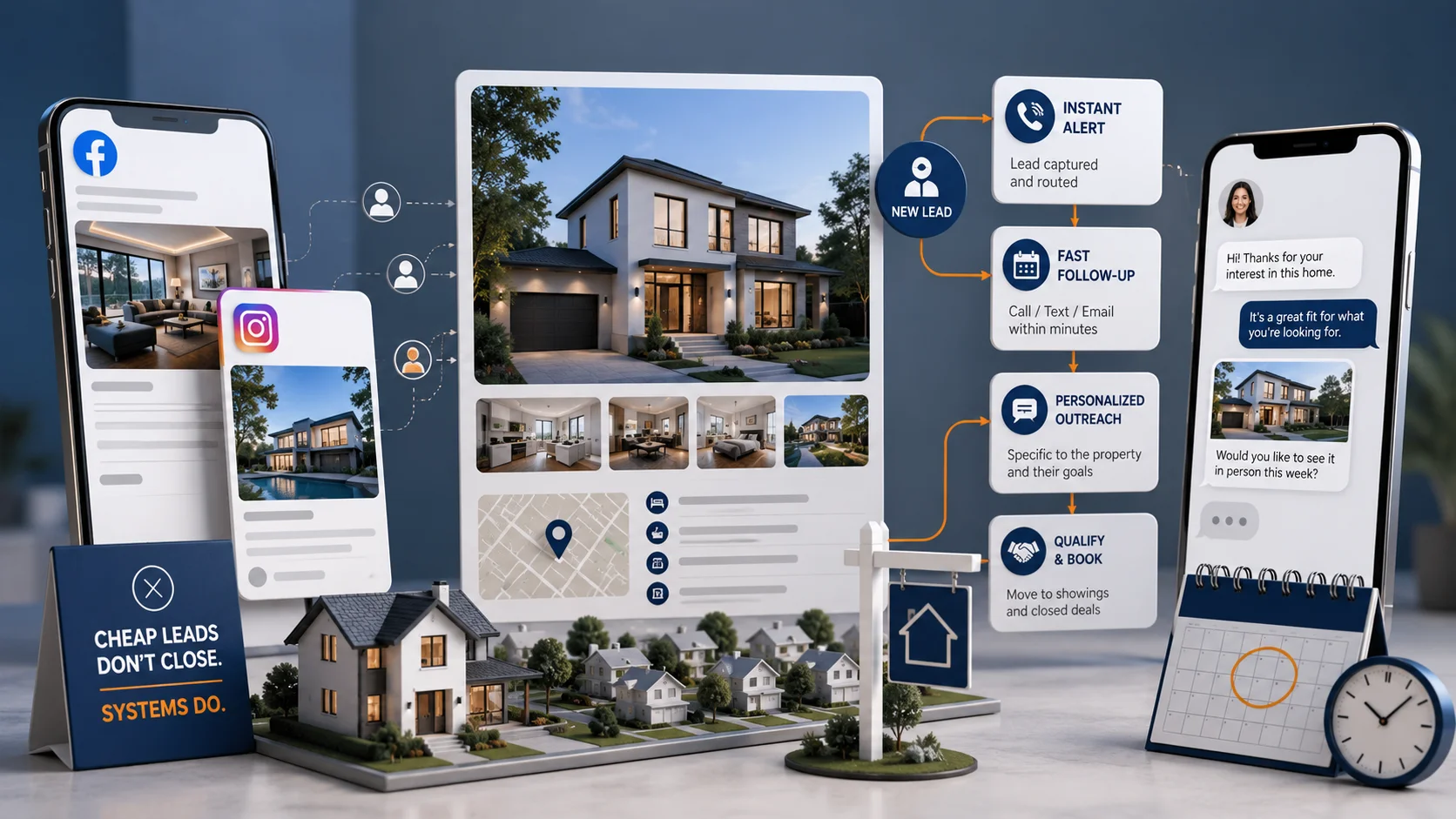
Real estate is one of the most common Meta Ads use cases, and also one of the most commonly done badly. It's easy to generate a large volume of cheap leads through a Facebook lead form — and just as easy to discover that most of them never pick up the phone, because instant-form lead generation without a genuinely fast, well-structured follow-up process produces exactly that outcome. The agents and brokerages who actually convert Facebook and Instagram traffic into closed deals build the whole system, not just the ad.
Looking for someone to run this for you? Message me directly on WhatsApp — I manage Meta Ads for real estate agents and brokerages, built around genuine lead quality and follow-up, not just a low cost-per-lead number that doesn't translate into closed deals.
Why real estate lead generation on Meta specifically goes wrong
The core problem is almost always a mismatch between how easy Meta makes it to generate a lead and how much genuine intent that lead actually represents:
- Instant lead forms let someone submit their details within Facebook or Instagram with essentially one tap, without ever visiting a website or engaging meaningfully with the agent's brand — this produces a low cost per lead, but a meaningful share of those leads have low genuine intent.
- No immediate follow-up system, meaning a lead who was genuinely interested at the moment of submission cools off, gets distracted, or gets contacted by a competing agent first, before your team ever reaches out.
- Generic follow-up scripts that don't reference the specific property, listing type, or ad the lead actually responded to, making the follow-up feel impersonal and reducing the odds of a genuine conversation starting.
None of this means lead form ads are a bad tool — it means they need to be paired with a follow-up system built for genuine speed and relevance, not left to whatever ad-hoc process happens to be in place.
Lead forms versus landing pages: choosing deliberately
| Approach | Cost per lead | Average lead intent | Best suited to |
|---|---|---|---|
| Native Facebook/Instagram lead form | Lower | Lower | High-volume top-of-funnel campaigns, broad market awareness |
| Dedicated landing page | Higher | Higher | Specific listings, higher-value properties, motivated-seller campaigns |
| Messenger/WhatsApp-based lead capture | Moderate | Moderate-high | Agents who can respond conversationally and quickly |
Many successful real estate Meta Ads strategies run a genuine mix — lead forms for broad awareness and pipeline building, landing pages for specific high-value listings or motivated-seller campaigns where a higher-intent, more qualified lead matters more than volume.
The follow-up system that actually converts leads
This is where most of the real difference between agents who succeed with Meta Ads and agents who conclude "it doesn't work" actually lies:
- Speed matters more than almost anything else — studies on lead response time consistently show contact within the first few minutes dramatically outperforms even a same-day follow-up, since interest is highest at the moment of submission and decays quickly afterward.
- Automated instant acknowledgment, even before a human follow-up call, keeps the lead warm and signals genuine responsiveness — a simple automated text or message confirming receipt and setting an expectation for a callback.
- Follow-up that references the specific ad or listing, not a generic "thanks for your interest in real estate" script — this single change measurably improves engagement, since it demonstrates the lead wasn't just dropped into an anonymous queue.
- A defined multi-touch follow-up sequence, since a genuine prospect rarely converts on the first contact attempt — a real estate lead nurture sequence over days or weeks, mixing calls, texts, and value-adding content, consistently outperforms a single call-and-done approach.
Targeting strategy for real estate specifically
- Geographic precision matters more here than in most industries — a real estate audience is inherently local, and overly broad geographic targeting wastes spend reaching people who could never realistically buy or sell in the relevant area.
- Life-event and interest-based targeting (recently engaged, new job changes, home improvement interest) can surface people at relevant life stages, though this should be tested against performance rather than assumed to automatically outperform broader targeting.
- Retargeting website visitors and past lead form starters who didn't complete captures genuine, already-demonstrated interest at a typically lower cost than fresh cold-audience targeting.
- Lookalike audiences built from past closed clients, where available, can be a genuinely powerful targeting source, since they're modelled on people who've already demonstrated the strongest possible signal — an actual completed transaction.
Creative that works for real estate specifically
Property photography and video consistently outperforms generic stock imagery or agent headshot-led creative for cold audience prospecting — a compelling property video tour, a well-shot carousel of a specific listing, or genuine neighbourhood content tends to stop the scroll considerably more effectively than a standard "I can help you buy or sell" static ad. For agents without in-house video capability, even a simple, well-lit phone-shot walkthrough often outperforms a generic stock photo ad, since authenticity reads as more trustworthy in a relationship-driven industry like real estate.
Instagram-specific considerations for real estate
Instagram deserves its own attention rather than being treated as a simple mirror of a Facebook campaign, since audience behaviour genuinely differs between the two platforms:
- Stories and Reels placements tend to reward vertical, native-feeling video content over polished, horizontally-shot property photography repurposed from a listing site — content that looks like it was made specifically for the platform generally outperforms recycled listing photos.
- Instagram audiences skew somewhat younger and more visually driven, which can make it a particularly strong channel for lifestyle-oriented property content (a renovated kitchen, a garden transformation, a neighbourhood walk-through) over purely transactional "3 bed, 2 bath, offers over" listing-style creative.
- Carousel posts performing well organically on an agent's own profile are often strong candidates to boost or run as paid ads, since organic engagement is a genuine signal of what that specific audience responds to.
- Consistent posting alongside paid campaigns builds a stronger overall brand presence a prospective lead can check before converting — a lead who clicks through to an Instagram profile with a thin, inconsistent posting history reads very differently to one who finds an active, professional, locally-relevant presence.
Realistic budget and timeline expectations
Real estate Meta Ads campaigns typically need a meaningful testing period before performance stabilises — commonly four to eight weeks of consistent spend and iteration before an agent has a genuinely reliable read on cost per lead, appointment rate, and eventual cost per closed deal for their specific market and property type. Budgeting for this testing phase separately from an expected "steady state" budget helps set realistic expectations from the outset, rather than judging the campaign's viability from its first two weeks, before creative, targeting, and the follow-up process have all had a genuine chance to be refined based on real performance data.
A worked example of fixing a lead-quality problem
A brokerage running Facebook lead ads was generating leads at a low £8 cost per lead, but sales agents reported barely 10% were answering follow-up calls, and almost none converted to an actual appointment. Reviewing the process revealed leads weren't contacted until, on average, four hours after submission, using a single generic script regardless of which listing or campaign generated the lead.
The fix: implementing an automated instant text acknowledgment the moment a lead was captured, cutting the actual human follow-up call window to under 15 minutes during business hours through a dedicated response process, and rewriting the follow-up script to reference the specific property or area from the ad. Within a month, phone answer rates on follow-up calls roughly tripled, and appointment-setting rate from answered calls improved meaningfully as well — the ad targeting and creative hadn't changed at all; the entire improvement came from the follow-up system.
Buyer-lead campaigns versus seller-lead campaigns
These deserve genuinely separate strategies, since the audience psychology and creative approach that works for one often underperforms for the other:
- Buyer-lead campaigns generally perform well with strong property visuals, specific listing content, and lookalike audiences built from past buyer clients — the creative itself often does most of the work, since buyers are naturally drawn to properties that visually appeal to them.
- Seller-lead campaigns typically need a different creative approach entirely — content around market value, "what's my home worth" style lead magnets, and messaging that speaks to a homeowner's specific motivations for selling (downsizing, relocating, market timing) rather than property photography, since the seller isn't browsing listings, they're evaluating whether now is the right time to sell and whether you're the right agent to trust with that decision.
- Running both simultaneously without distinguishing them in campaign structure and creative is a common reason agents see mediocre performance across the board — the messaging that attracts a motivated seller lead is often meaningfully different from what attracts a browsing buyer, and blending the two dilutes both.
A brokerage or agent running meaningful Meta Ads volume typically benefits from maintaining genuinely separate campaigns, creative, and even landing pages for buyer- and seller-focused lead generation, rather than trying to capture both audiences with one generic "I can help with real estate" campaign.
Common mistakes real estate agents make with Meta Ads
- Treating lead generation as the finish line, without investing equally in the follow-up system that actually converts leads into appointments and deals.
- Using lead form ads exclusively, missing the higher-intent leads a well-targeted landing page campaign can generate for specific listings.
- Targeting too broadly geographically, wasting spend on an audience that could never realistically transact in the relevant market.
- Using generic stock creative instead of genuine property and neighbourhood content that actually demonstrates local expertise and inventory.
- Judging campaigns purely on cost per lead, without tracking through to appointments set and deals closed — a cheap lead that never converts is more expensive than an costlier one that does.
Compliance and platform-specific advertising rules
Real estate advertising on Meta operates within Meta's Special Ad Category rules for housing-related ads, which restrict certain targeting options (age, gender, and some location-based targeting) to prevent discriminatory housing advertising practices. This is a genuinely important compliance consideration, not an optional detail — campaigns need to be correctly categorised as housing ads from the outset, and targeting strategy needs to be built within these constraints rather than around them. An agent or agency unfamiliar with these specific rules can inadvertently set up a campaign that either violates policy (risking account restrictions) or unnecessarily under-targets out of caution, missing genuinely available targeting options that remain compliant.
What a serious Meta Ads engagement should include for a real estate business
The list below is what Meta Ads management actually involves for an agent:
- A targeting and campaign strategy matched to your specific market and property types, not a generic template.
- A deliberate mix of lead form and landing page campaigns, matched to the right use case for each.
- A follow-up system built alongside the ad campaign, not left as an afterthought — including automated acknowledgment and a defined multi-touch sequence.
- Genuine property and local content creative, not generic stock imagery.
- Reporting tracked through to appointments and closed deals, not just cost per lead — the number that matters to an agent is closed commission, not a cheap lead count.
If your Meta Ads campaigns are generating leads that don't convert, message me directly on WhatsApp — I'll take a look at both your campaign and your follow-up process, since the fix is very often in the second one, not the first, and it's rarely obvious which one is actually responsible without a proper review of both.
 Connect on LinkedInChat on WhatsApp
Frequently asked questions
Why do my Facebook lead ads generate cheap leads that never answer the phone?
This is almost always a combination of two things: instant-form lead ads that make it too easy to submit low-intent information with a single tap, and a follow-up process that's too slow to catch genuine interest while it's still fresh. Fixing either alone helps; fixing both together is what actually moves the needle on lead quality and answer rates.
Should real estate agents use lead form ads or send traffic to a landing page?
Both have a place, and the right choice depends on the goal — native lead form ads (where someone submits within Facebook or Instagram without leaving the app) generally produce a lower cost per lead but lower average intent, while a dedicated landing page adds friction that naturally filters for more motivated prospects, usually at a higher cost per lead but better close rate. Many successful agents run both, for different campaign objectives.
How much should a real estate agent budget for Meta Ads?
This varies by market competitiveness and average commission value, but a useful way to think about it: work out what one closed deal is worth to you, then decide how many leads and what cost per lead you can sustainably afford while still being clearly profitable, and budget from there rather than picking an arbitrary monthly figure.
Is Meta Ads better than Google Ads for real estate agents?
They serve different intent levels and generally work best together rather than as alternatives — Google Ads captures people actively searching with clear buying or selling intent, while Meta Ads is stronger at reaching people who aren't actively searching yet but match a strong target profile, making it particularly effective for building a broader pipeline rather than only capturing already-active searchers.
What's the biggest mistake real estate agents make with Facebook ads?
Treating lead generation as the finish line rather than the start — investing significant budget in generating leads, then following up slowly, inconsistently, or with a generic script that doesn't match the specific ad or property that generated the interest. The follow-up process is frequently a bigger lever on actual results than the ad campaign itself.
Can Meta Ads work for a solo agent, or is it only worth it for larger brokerages?
It can work well for a solo agent, provided expectations and budget are realistic for the scale — a solo agent doesn't need the lead volume a large brokerage needs, and a smaller, well-targeted, well-followed-up campaign can produce a genuinely strong return relative to a modest budget, often outperforming a larger, less carefully managed campaign on a cost-per-closed-deal basis.
Get direct help with this

Ready to Grow Your Business?
Whether you're recovering an eBay account, launching an Amazon brand, improving your SEO, or scaling with AI automation, let's discuss the best strategy for your business.
Chat on WhatsApp Now