Local SEO for Service Area Businesses: How to Rank on Google Maps Without a Storefront

 Chat on WhatsApp
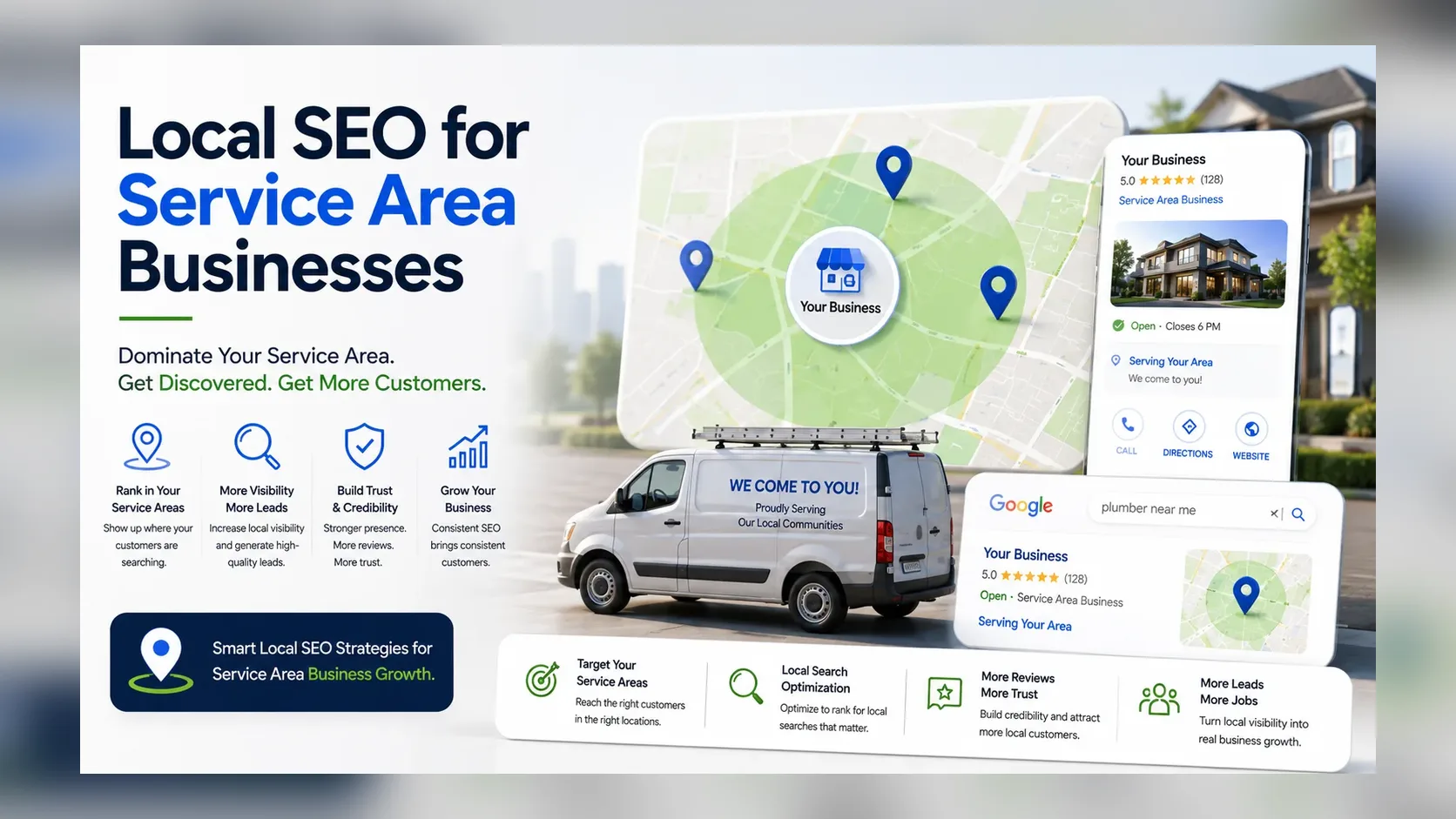
A legitimate service-area business can use Google Business Profile without displaying a customer-facing storefront address. If the business travels to customers and doesn't serve them at its base, Google generally requires the public address to be hidden and service areas configured instead. But service areas are not ranking zones — they tell Google and customers where you operate, nothing more. Ranking still depends on Google's local-ranking systems, including distance from the searcher, alongside relevance and prominence. Which means ranking across multiple towns takes considerably more than adding those towns to a list in your profile settings.
How Does Local SEO Work for a Service-Area Business?
It starts with the correct Google Business Profile type: hide the public address if you don't serve customers there, select the most accurate primary category, and list genuinely served areas — up to 20, using cities or postal codes rather than a radius. From there, ranking depends on the same framework as any local business: relevance (accurate category and services), distance (which service areas don't override), and prominence (reviews, authority, genuine proof). A website with real service pages, legitimate local proof, and a consistent flow of reviews supports all three. No configuration setting substitutes for that underlying work.
The Service-Area Local SEO Model
A Rizwan Strategy framework — not Google's official ranking model.
- Eligibility & GBP setup — the business type, address visibility and service areas are configured correctly. Fully controllable; the most common mistake is skipping this and going straight to marketing.
- Service relevance — category and services genuinely match what customers search for. Fully controllable; the mistake is padding for keywords instead of accuracy.
- Geographic relevance — distance from the searcher, which service-area selection doesn't change. Largely uncontrollable; the mistake is believing this layer can be optimised away.
- Prominence & trust — reviews, authority, genuine local proof. Controllable over time; the mistake is expecting it to compensate instantly for weak geographic relevance.
- Conversion — turning visibility into calls and enquiries. Fully controllable; frequently neglected in favour of chasing more visibility instead of using what's already there.
What Is a Service-Area Business on Google?
A service-area business (SAB) travels to or delivers to customers and does not serve them at its business address (Business Profile for service businesses overview) — a plumber, mobile groomer, or pest-control company are typical examples. This differs from a storefront, where customers visit a staffed, signed location during stated hours, and from a hybrid business, which does both — some in-person trade plus travel or delivery.
| Business type | Customers visit location? | Business travels to customers? | Show address? | Service area? | Example |
|---|---|---|---|---|---|
| Storefront | Yes | No | Yes, public | Not typically needed | Retail shop, dine-in restaurant |
| Service-area | No | Yes | Hidden | Yes | Plumber, mobile mechanic |
| Hybrid | Yes | Yes | Yes, public | Yes | Locksmith with a shop who also does callouts |
Should a Service-Area Business Show Its Address?
No, if the business doesn't serve customers there. Google's rule for service-area and hybrid businesses without in-person customer contact at their base is to hide that address from the public profile (Manage your service areas). The underlying address still matters to Google for verification and distance calculations — it's simply not shown publicly. This doesn't apply to a genuine storefront or hybrid business that does receive customers at its location — hiding a real, customer-facing address would misrepresent how that business actually operates.
Can You Use a Home Address for Google Business Profile?
Yes, provided it's genuine and hidden appropriately — a real home-based service business can use its actual operating address for verification while keeping it hidden from the public, on the same basis as any service-area business that doesn't serve customers at its base. There's no need to display a residential address publicly, and no requirement to expose sensitive personal details when filming verification video — location and business-existence evidence can be shown without it. This is different from fabricating a fake business address purely to appear eligible, which risks a representation-policy problem, not just a rejected setup.
How to Add or Edit Service Areas in Google Business Profile
From your Business Profile, go to Edit profile → Location, then manage the service area under the relevant section — add cities, postal codes, or other supported named areas rather than a radius, which Google no longer supports as a selection method. Approved edits can take up to 48 hours to appear on the live profile (Manage your service areas) — don't assume a change failed just because it hasn't shown within minutes.
How Many Service Areas Can You Add?
Up to 20, based on cities, postal codes, or other named areas, and the overall coverage should generally stay within about two hours' driving time of the business base (Manage your service areas). As of a mid-2025 policy update, Google also no longer permits entire countries or states as service areas — named local areas only. The technical ceiling of 20 is not a target: list what you genuinely serve, not what you're technically permitted to list.
Does Adding More Service Areas Help You Rank Higher?
No — and this is the single most important correction in this article. Adding service areas is not a ranking-radius strategy. Google's local ranking still runs on relevance, distance, and prominence, and selecting a service area doesn't relocate the business or change how distance is calculated for a given search.
Myth: add every nearby city to the service-area list and rank in all of them. Reality: service areas tell Google and customers where you genuinely operate; actual ranking in each area still depends on real relevance, genuine distance, and prominence built through legitimate signals — website strength, reviews, and authority.
How Far Can a Service-Area Business Rank From Its Base?
There's no fixed, universal ranking radius, and no honest answer claims one — how far a business ranks varies by searcher location, category, competition, the specific query, and the business's own relevance and prominence. Google's roughly two-hour driving-time guidance is an operational limit on what you're allowed to list as your service area — it is not a promise of ranking strength throughout that radius. Conflating the two is one of the most common and most damaging misunderstandings service-area businesses have about their own profile.
Why Is My Service-Area Business Not Showing on Google Maps?
Before assuming a ranking problem, rule out a setup one: an unverified profile, an eligibility or configuration issue, an incorrectly configured hidden address, the wrong category, a suspension or restriction, or an unresolved duplicate. A business that shows for its name but not for service searches has a different, ranking-specific problem rather than a missing-profile one. See why your business isn't showing on Google Maps for the fuller diagnostic.
Choose the Correct Primary Google Business Profile Category
The category should describe what the business genuinely is — Plumber, Electrician, Roofing contractor, Pest control service, House cleaning service — chosen as specifically and accurately as the business allows, not selected or changed to chase a competitor's apparent success. Relevant secondary categories can describe genuine additional aspects; they shouldn't be added simply to cover more locations, which categories don't do. See the complete Google Business Profile optimization guide for the full field-by-field picture.
Add the Services Customers Actually Hire You For
List real, specific services — for a plumber: boiler repair, leak repair, toilet repair, emergency plumbing — described accurately, not padded with repeated location or price keywords disguised as service names. Relevance comes from an honest, specific list, not from volume.
Serving Multiple Areas but Only Ranking Near Your Base?
Request a free initial service-area Local SEO audit. I'll review your Google Business Profile configuration, primary category, service areas, website structure and obvious geographic visibility gaps and tell you what I'd prioritize first.
Get My Free Service-Area Audit →
Build a Website That Supports Service-Area Local SEO
The website matters more, not less, once the public GBP address is hidden — it becomes the clearest place a prospective customer can actually verify the business is real and competent. It needs: dedicated pages for each major service where search demand genuinely justifies it; clear identity — who you are, what you do, your real operating region, and how to contact you; local proof — real completed projects, customer examples, case studies, and photos rather than stock imagery; accurate, consistent contact details; internal links connecting services, locations, and proof; content search engines can actually crawl; and, on every page, a clear service, some proof, and an obvious way to get in touch. See professional Local SEO and website optimization for the fuller version of this.
Do Service-Area Businesses Need Location Pages?
Potentially — but not hundreds of thin ones. A location page earns its place when it holds genuinely distinct, location-specific value: real project examples from that area, testimonials from customers there, travel or service considerations specific to it, relevant local knowledge, or pricing differences that are actually real. A page that's identical to twelve others except for a swapped city name provides none of that, and Google and users can both tell the difference — this is a well-documented pattern that underperforms and risks reading as low-quality content produced at scale, not a shortcut to more visibility.
Service Pages vs Location Pages: What Should You Build?
| Search intent | Recommended page | Example |
|---|---|---|
| A specific service, non-branded | Service page | "Emergency plumber" |
| A service plus a specific area, with genuine demand and content to justify it | Service-location page | "Boiler repair in Leeds," if there's real local proof to include |
| A city plus the business type generally | Location page, only if genuine local presence/proof exists | "Plumber in Leeds" |
| A general informational question | Guide/informational content | "How much does boiler repair cost?" |
Building a service-location page purely because the search term exists, without anything genuine to put on it, risks cannibalising your own core service page rather than adding coverage.
The Service × Location Content Matrix
A Rizwan Strategy planning framework — decide by cell, not by defaulting to "yes" everywhere.
For each service × priority-area combination, classify as: no page needed (low demand, no distinct content available), supporting mention (referenced within a broader page), location page (genuine local proof and demand exist), service-location page (both a specific service and a specific area justify a dedicated page), or case study (a real completed job in that area, presented as proof rather than a landing page). Most combinations in a realistic grid should land in the first two categories — that's the sign the matrix is being used honestly rather than as an excuse to build pages everywhere.
How to Create Strong Service-Area Location Pages
Where a page is genuinely justified, a practical structure: an H1 stating the service and area plainly; a direct-answer opening; the specific services offered there; why local customers choose the business; a real project or case study from that area; the service process; genuine coverage detail; pricing factors where honestly relevant; testimonials from actual local customers; a short FAQ; a clear call to action; and links back to the core service pages. Don't invent a "Manchester Office" or "Leeds Branch" that doesn't exist to make the page feel more locally rooted than the business genuinely is.
Build Local Proof Without Pretending You Have an Office There
Legitimate local proof: completed jobs and project photographs, genuine customer reviews from that area, real case studies, honest before/after examples, and real partnerships, sponsorships, or community involvement where they exist. What undermines trust the moment a prospective customer checks: a page claiming a branch, office, or headquarters in a city where the business has no actual presence. This is exactly the kind of misrepresentation Google's guidelines address, and it damages credibility with real customers regardless of any policy risk.
Not Sure Which Locations Need Their Own Pages?
Send me your website, main services and priority locations. I'll review the basic service/location architecture and identify where dedicated pages may make sense — and where they would probably create duplicate or thin content.
Audit My Local SEO Structure →
Get Genuine Reviews From Customers Across Your Service Area
A broad, genuine review base across the areas you actually serve supports prominence — but don't ask customers to insert specific city or service keywords, and don't incentivise reviews from any area. See how to get more genuine Google reviews for the full, compliant process.
Build Local Links and Mentions in the Areas You Serve
Legitimate authority-building for a service-area business looks the same as for any local business: coverage in local publications, business associations, industry bodies, supplier relationships, genuine sponsorships, and real project collaborations. Buying links or citations "per city" to simulate a local presence you don't have doesn't build genuine prominence — it creates a paper trail that looks exactly like what it is.
Can Citations Help a Service-Area Business?
Consistent, accurate business information across legitimate directories and platforms supports entity clarity and trust — it helps disambiguation, not ranking by volume. Mass low-quality directory submission doesn't reliably produce a Maps ranking outcome; a handful of accurate, relevant listings does more than hundreds of low-value ones.
Can a Service-Area Business Have Multiple Google Business Profiles?
Google allows one profile per business — creating separate profiles simply to cover different cities is a duplicate risk, not a strategy (Resolve duplicate profiles & ownership issues). Genuinely separate, distinct businesses (different names, different signage) at the same address can each have a profile — that's a different scenario entirely from one business trying to multiply its presence.
| Scenario | Separate profile? | Why |
|---|---|---|
| One plumber operating from one base, serving five towns | No | One business, one profile, service areas configured |
| A company with two genuinely separate, staffed operational locations | Potentially, one per genuine location | Each is a real, distinct operating base |
| A virtual office rented in another city | No | Doesn't reflect where the business genuinely operates |
| A temporary rented desk used to create eligibility | No | Representation-policy risk, not a legitimate location |
| A legitimate second branch with its own staff | Potentially, per location | Genuine, separately operated business location |
Why Do Competitors With Hidden Addresses Rank Above Me?
A hidden address doesn't prevent ranking — plenty of the businesses outranking you are configured exactly the same way. More likely explanations: stronger category alignment, a genuinely closer relationship to the searcher for that specific query, stronger reviews, a more relevant website, more established authority, or simply longer-earned prominence. See how to rank higher on Google Maps for the fuller ranking breakdown.
Service-Area Business Verification
Verification for a service-area business follows the same video-evidence principles as any business — location context, proof the business exists (tools, equipment, workspace), and proof of management — without needing to expose a private address publicly. See the complete Google Business Profile verification guide for the full process.
Local SEO for a Home-Based Service Business
A practical model: address hidden, accurate service areas configured (not maximised), the correct primary category, a real, specific service list, a website with genuine core service pages, a small number of well-justified location pages, real job case studies, a compliant review process, legitimate local links, and a clear call/WhatsApp path to conversion. Home-based doesn't mean fake or online-only — it means the customer-facing part of the business happens somewhere other than a public storefront, which is a completely normal, eligible configuration when set up honestly.
How Should a Service-Area Business Track Google Maps Rankings?
Searching once from the owner's own phone tells you almost nothing — results vary by exact searcher location. Track a defined group of target keyword-and-area combinations, ideally from multiple points across your actual service area, alongside branded versus non-branded search comparisons and your Business Profile Performance data (views, calls, website clicks, direction requests).
| What you're measuring | What it tells you | What it doesn't tell you |
|---|---|---|
| Visibility (rank/views) | Whether you're being shown | Whether it converts to a lead |
| Calls / website clicks | Genuine interest generated | Whether it became a booked job |
| Enquiries / lead quality | Actual commercial outcome | Where exactly the gap is if this is low |
Why Does My Business Rank Near Me but Not in Other Service Areas?
Because selecting a service area doesn't relocate the business for Google's ranking calculations — distance remains part of the framework, alongside relevance and prominence, regardless of what's listed in your service-area settings. What genuinely helps at the margins: stronger website relevance for that area, real customer and project proof there, earned authority, and consistent reviews. None of it fully overcomes a genuine proximity disadvantage — it improves your competitive position within that constraint, not around it.
Can You Rank in a City Where You Don't Have an Office?
Potentially, for some searches — but there's no guaranteed strategy that makes Google treat a service-area business as if it were physically located in a distant city. Two separate levers exist: Maps visibility, which is genuinely constrained by distance, and organic search visibility, which can work differently — a well-built, genuinely valuable page can rank organically for a city you serve even where Maps proximity limits your local-pack presence. Running both isn't a guarantee, but it's a more honest strategy than treating Maps as the only channel.
Service-Area Expansion Ladder
A Rizwan Strategy strategic framework — for genuinely growing a service footprint, not gaming one.
- Win visibility around your real operating base first — this is the foundation everything else builds on.
- Strengthen your core services before expanding geographic ambition.
- Build genuine proof in nearby target areas — real jobs, real customers.
- Create valuable priority location pages only where the proof and demand justify them.
- Earn local authority in those specific areas over time.
- Track actual visibility and leads, not just service-area settings.
- Consider genuine operational expansion — a real second base — only if the market and economics justify it.
A virtual office is not operational expansion. It's a shortcut that skips every step above and typically fails for exactly that reason.
Competitors Ranking Across Areas You Serve?
Send your business name, main service and target areas. The initial audit will compare your profile, website, reviews and local visibility with the businesses currently competing for those searches.
Check My Google Maps Visibility →
Service-Area Business Local SEO Mistakes
Displaying a home address publicly when customers aren't served there; using a fake storefront or virtual office to manufacture eligibility; creating a separate profile for every city instead of one properly configured profile; adding all 20 service areas regardless of whether they're genuinely served; treating service area as a ranking radius; keyword-stuffing the business name; choosing categories for search volume rather than accuracy; building hundreds of thin, near-identical location pages; copying location-page content and swapping only the city name; incentivised or fake reviews; ignoring the website entirely while chasing profile edits; ignoring genuine proximity disadvantages; claiming fake local branches; mass low-quality citation building; and judging performance from a single manual search. Each substitutes the appearance of expansion for the genuine local relevance and proof that actually earns it.
Service-Area Business Local SEO Checklist
| Priority | Area | What to check | Action | Purpose |
|---|---|---|---|---|
| Critical | Business type | Correctly set as service-area or hybrid | Confirm and correct if wrong | Eligibility |
| Critical | Address visibility | Hidden if no in-person customer contact at base | Toggle off "Show business address" | Policy compliance |
| Critical | Verification | Fully verified | Complete if not done | Foundation |
| Profile | Service areas | Genuinely served, not maxed out | Trim to real coverage | Accuracy |
| Profile | Service-area format | Cities/postal codes, not radius or country/state | Reconfigure if outdated | Policy compliance |
| Profile | Primary category | Accurately describes the business | Correct if generic | Relevance |
| Profile | Services | Real, specific offerings | Rewrite padded entries | Relevance |
| Website | Core service pages | Exist for each major service | Build/improve as needed | Relevance |
| Website | Location pages | Only where genuine local value exists | Remove or strengthen thin ones | Quality |
| Website | Local proof | Real projects, photos, case studies | Add genuine examples | Trust |
| Website | Contact/conversion path | Clear on every page | Add clear CTAs | Conversion |
| Authority | Local mentions | Genuine, relevant sources only | Pursue real coverage | Prominence |
| Authority | Citations | Accurate, not mass-submitted | Audit for consistency | Trust |
| Reviews | Volume across areas | Broad, genuine base | Build compliant request process | Prominence |
| Reviews | Response rate | Consistent replies | Establish a routine | Reputation |
| Structure | Duplicate profiles | None per-city | Consolidate into one profile | Policy compliance |
| Measurement | Rank tracking | Multi-point, not single-search | Set up proper tracking | Diagnosis |
| Measurement | Lead tracking | Calls/clicks tied to areas where possible | Review monthly | Commercial outcome |
Service-Area Visibility Scorecard
A Rizwan Strategy auditing framework — not Google's ranking score, and it does not mathematically predict Map Pack position. Score each 0–5, total out of 70: business eligibility, correct SAB configuration, verification, primary category, service relevance, service-area accuracy, website relevance, core service pages, priority location pages, reviews, local proof, local authority, conversion readiness, tracking. A low score anywhere is the place to start, regardless of the total.
Official Google Sources Used
- Business Profile for service businesses overview
- Manage your service areas for service-area & hybrid businesses
- Resolve duplicate profiles & ownership issues
- Guidelines for representing your business on Google
This guide reflects Google's official Business Profile Help documentation as of August 2026, including the 2025 policy update removing countries and states as valid service areas. Google's policies and interface change periodically — always confirm current requirements against Google Business Profile Help before configuring service areas.
Chat on WhatsAppFrequently asked questions
What is a service-area business on Google?
A business that travels to or delivers to customers rather than serving them at its own address — the public address is hidden and service areas are configured instead.
Can a service-area business rank on Google Maps?
Yes — hiding the address doesn't prevent ranking. Ranking depends on the same relevance, distance, and prominence framework as any local business.
Should a service-area business hide its address?
Yes, if it doesn't serve customers at that address — this is Google's own guidance, not just a preference.
Can a home-based business have a Google Business Profile?
Yes, if it's a genuine, eligible business — the home address can be used for verification while hidden from public view, the same as any service-area business.
How many service areas can I add?
Up to 20, using cities or postal codes, generally within about two hours' driving time of the business base — radius selection and whole countries/states are no longer supported.
Does adding more service areas improve ranking?
No. Service areas describe where you operate; they don't function as a ranking radius, and distance from the searcher still applies within them.
Why does my business only rank near my location?
Because distance remains part of Google's ranking framework regardless of your service-area settings — this is normal, not a sign of misconfiguration.
Can I rank in another city without an office there?
Potentially for some searches, particularly through genuine organic content, but there's no guaranteed way to be treated as physically located somewhere you're not.
Do service-area businesses need location pages?
Only where genuine, distinct local value exists — real proof, real demand — not as a template with the city name swapped.
Can I have Google Business Profiles in every city I serve?
No — one legitimate business gets one profile, with service areas configured; separate profiles per city risk a duplicate flag.
Can I use a virtual office for Google Maps?
No — using an address that doesn't reflect where the business genuinely operates is a representation-policy risk, not a legitimate expansion method.
How long does service-area Local SEO take?
There's no fixed timeline — it depends on your starting position, competition, and how much of the underlying website, review, and authority work is already in place. See [how long Local SEO normally takes](/blog/how-long-does-local-seo-take-realistic-timeline/) for a realistic picture.
Get direct help with this
Ready to Grow Your Business?
Whether you're recovering an eBay account, launching an Amazon brand, improving your SEO, or scaling with AI automation, let's discuss the best strategy for your business.
Chat on WhatsApp Now