Do you want your business to be found on Google, ChatGPT, Perplexity and Gemini?Do you want your business to be Get found on Google?ChatGPT?Perplexity?Gemini?
Custom Shopify Development and SEO Case Study: From a Dead UK Store to 11.5k Google Clicks in 3 Months
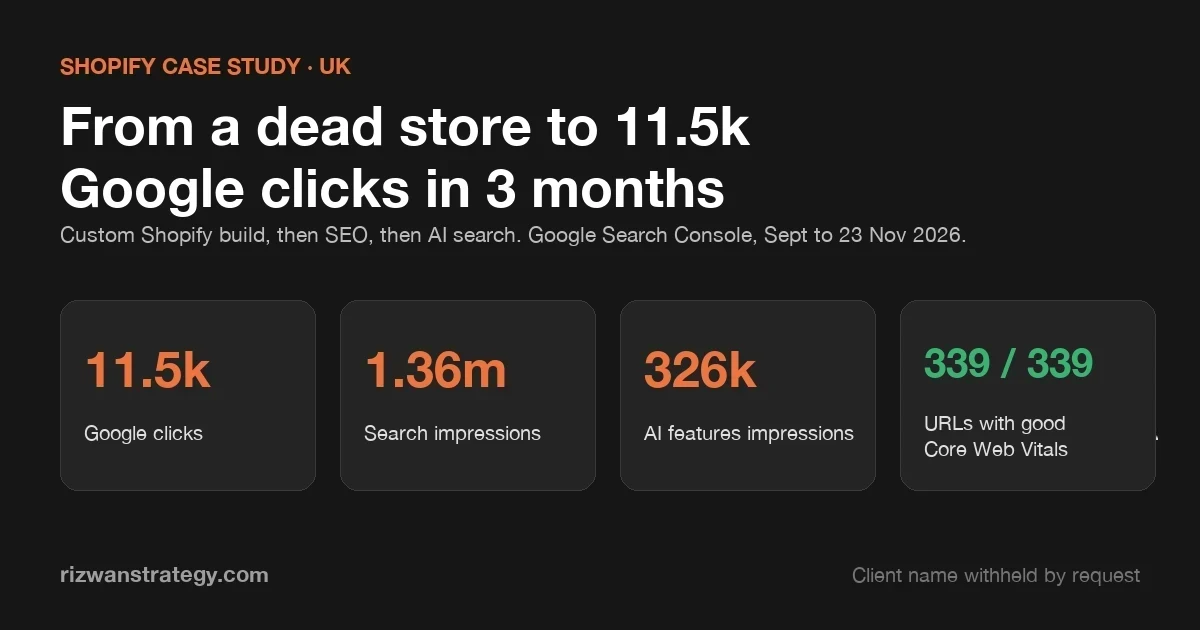
Custom Shopify development, then SEO: how a UK Shopify store went from almost no search traffic to 11.5k Google clicks, 1.36m impressions and 326k AI features impressions in about 3 months: custom store first, then SEO, then AI search.
I took over a basic UK Shopify store with almost no search traffic in September 2026. Custom Shopify development turned it into a premium, fully customised store, then I optimised it for Google and AI search. In about 3 months, from early September to 23 November 2026, it reached 11.5k Google clicks, 1.36m impressions and 326k AI features impressions.
Services that help with this
A fully branded store, built from scratch.
Shopify Store Development
Custom Shopify store development services from the ground up: theme coding, fully branded design, product and checkout setup, Shopify SEO built into the theme, and the automation that keeps orders, stock and customers running without manual work.
Generative engine optimisation (GEO) and answer engine optimisation (AEO) for businesses that want to be found and cited in ChatGPT, Google AI Overviews, Perplexity and Gemini. You work with me directly, not an agency team.
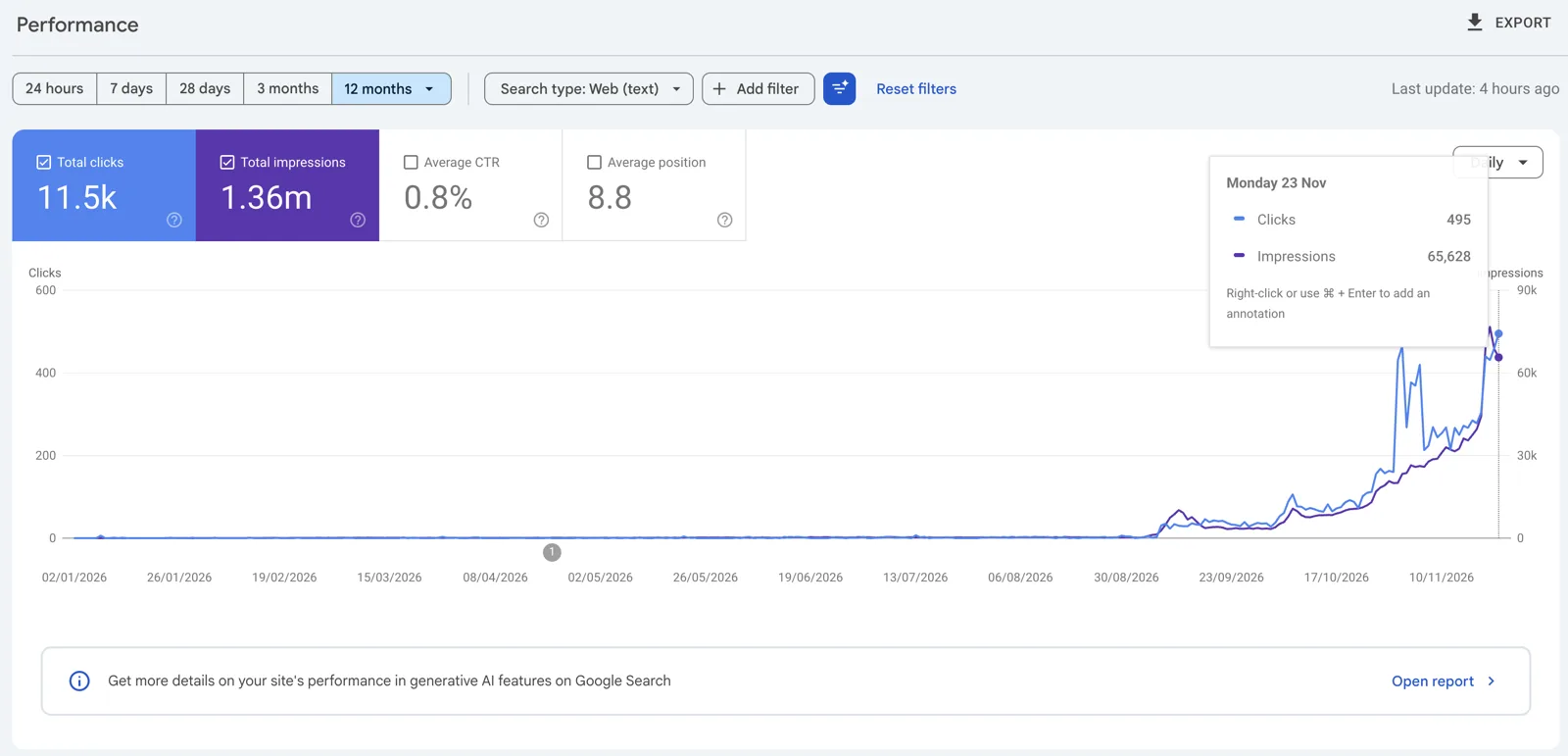
Google Search Console shows 11.5k clicks and 1.36m impressions for the store, almost all of them between early September and 23 November 2026, at an average position of 8.8.
Clicks were close to zero until late August 2026; the best day in the report, 23 November 2026, brought 495 clicks from 65,628 impressions.
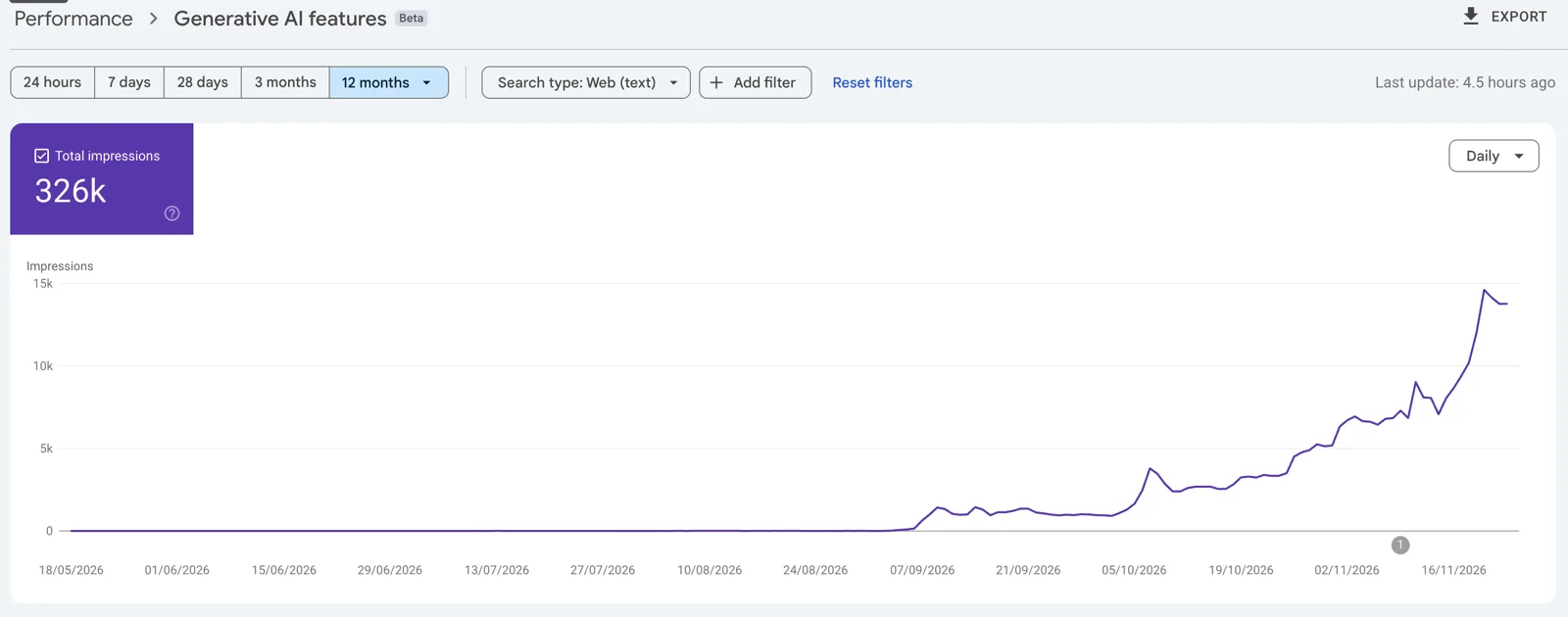
The beta Generative AI features report shows 326k impressions, rising from zero in early September to around 14,000 a day by late November.
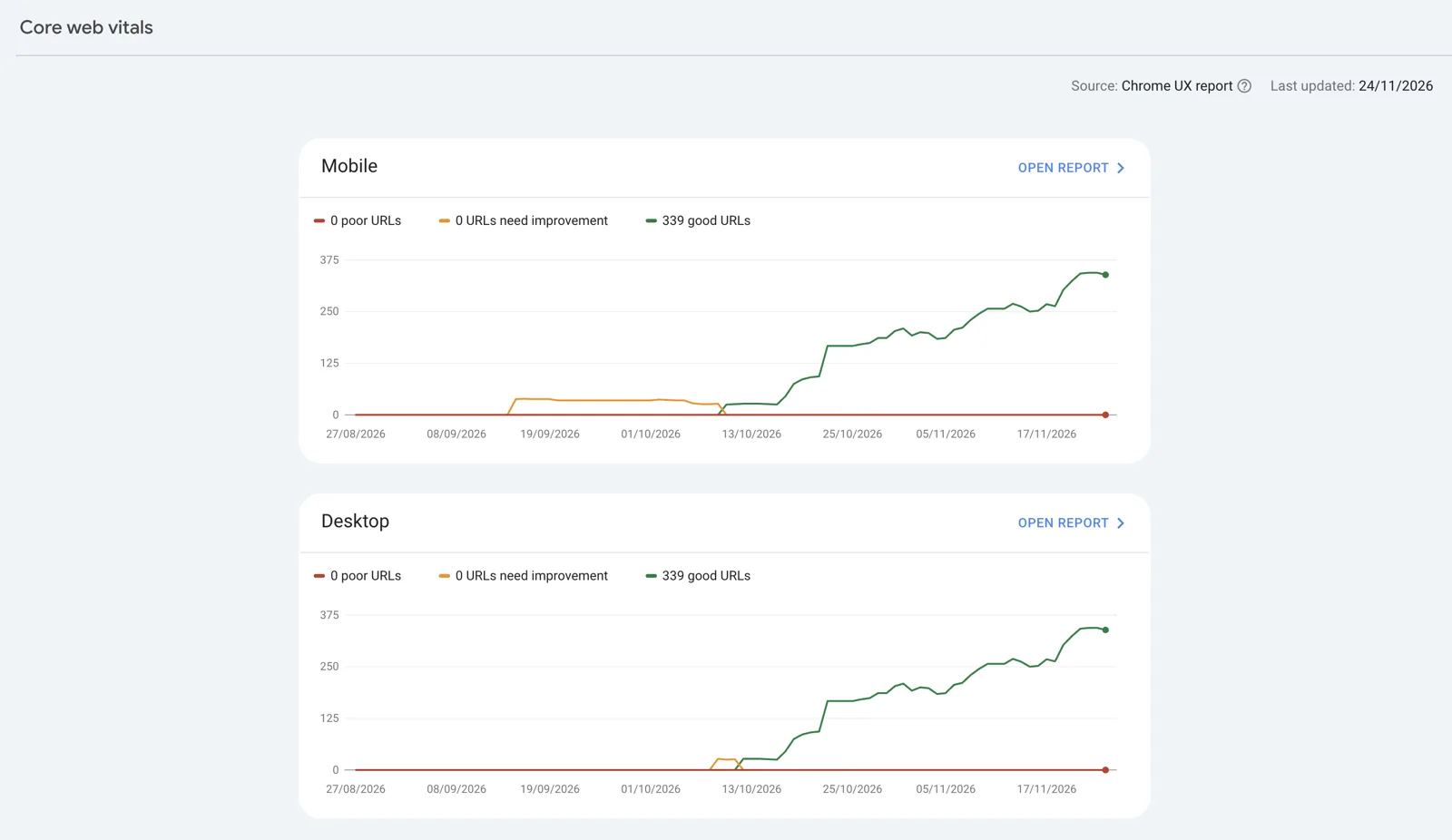
Core Web Vitals show 339 good URLs on both mobile and desktop, with 0 poor and 0 needing improvement.
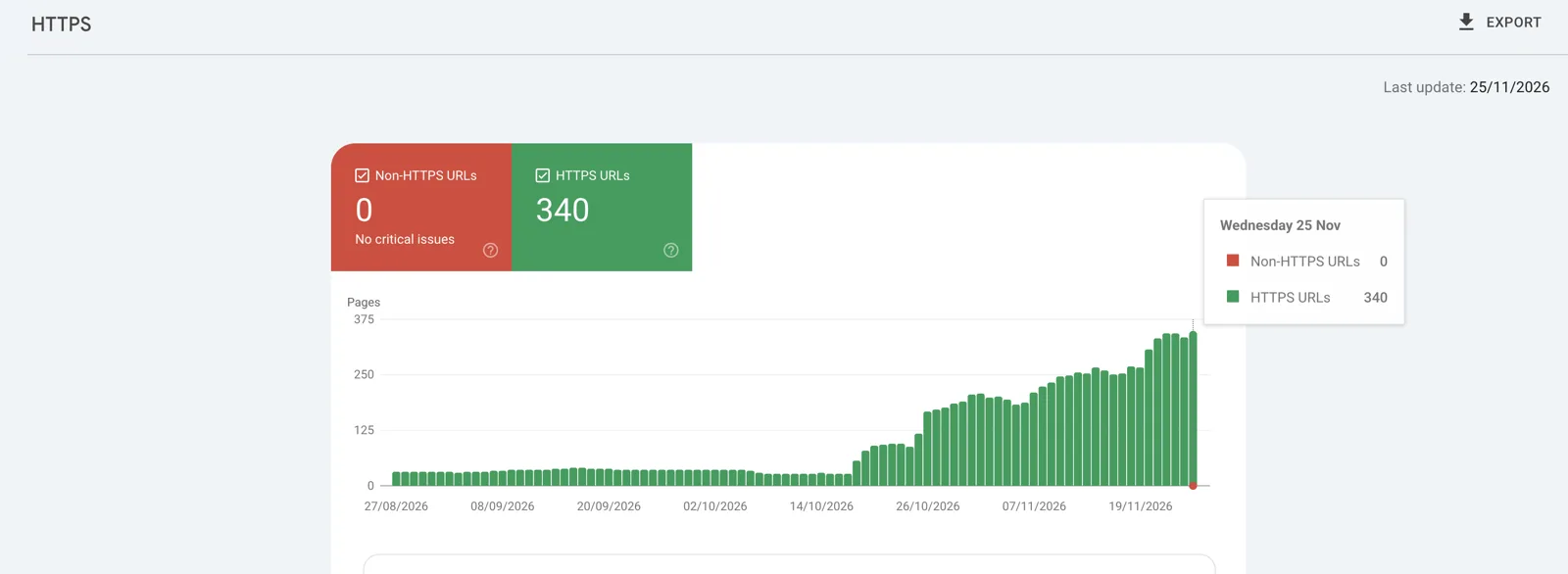
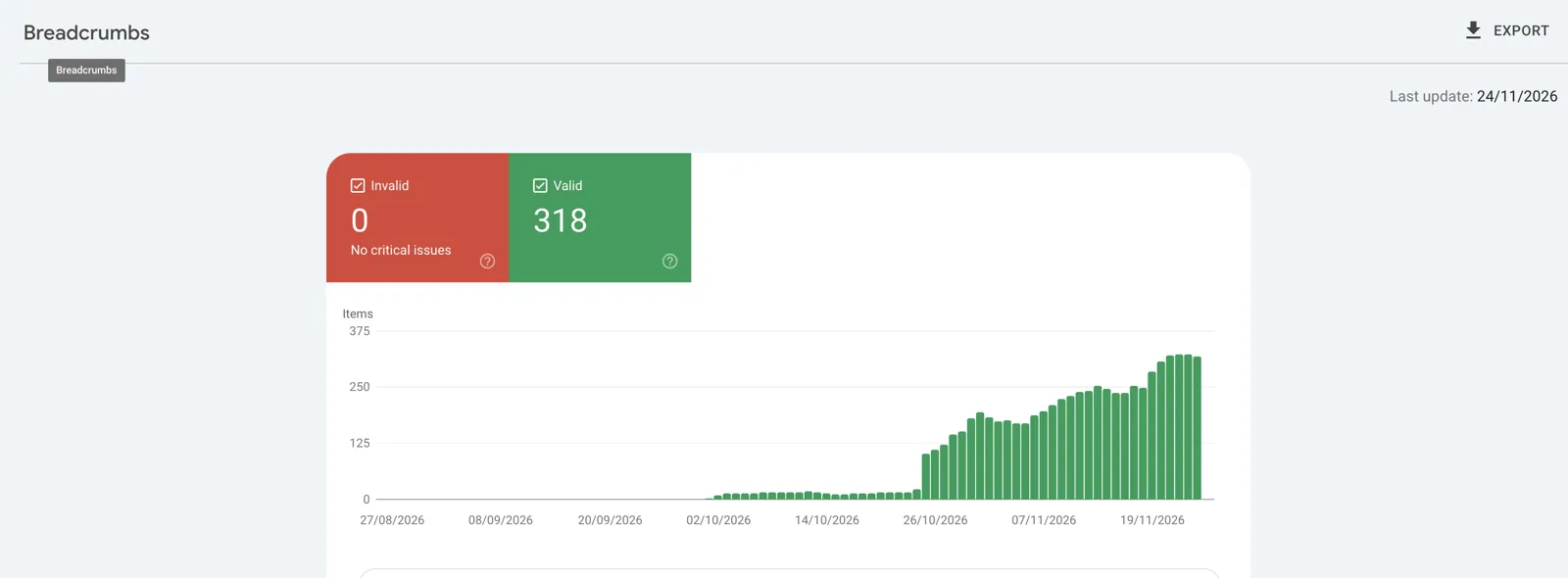
Search Console reports 318 valid breadcrumb items with 0 invalid, and 340 HTTPS URLs with 0 non-HTTPS URLs.
This Shopify store case study shows what happens when a UK store is fixed in the right order. I took over the store in September 2026. It was a basic Shopify store with almost no search traffic. I first developed it into a premium, fully customised, user-friendly store, then did the SEO, then made every page easy for Google's AI features and other AI search tools to read. In about 3 months, from early September to 23 November 2026, the store went from almost nothing to 11.5k Google clicks, 1.36m impressions and 326k AI features impressions, with every URL passing Core Web Vitals.
The owner asked me not to publish the store's name, so I won't. Every number below comes from the store's own Search Console reports. The totals are taken from the 12-month view, but the graphs are flat until late August, so almost all of it arrived in those three months. Revenue and conversion figures weren't part of what I was cleared to publish, so they're not here.
What did the store look like before September?
It was a basic Shopify store, and from a search point of view it was dead. The Search Console performance graph is flat along the bottom from January to the end of August 2026: almost no clicks, almost no impressions. People weren't finding the store on Google, and the AI features report shows nothing at all for that period.
That is a common starting point. Plenty of stores have a decent product range and a theme that looks fine on a laptop, yet Google sends them close to nothing. The usual causes are a slow mobile experience, thin or duplicate pages, collections that don't match how people search, missing structured data and no plan for which page should rank for what.
The results in numbers
Metric (Google Search Console)
Result
Period or date
Google clicks
11.5k
Almost all Sept to 23 Nov 2026
Search impressions
1.36m
Almost all Sept to 23 Nov 2026
Average position
8.8
12-month report
Best single day
495 clicks, 65,628 impressions
23 Nov 2026
AI features impressions (beta report)
326k
All Sept to late Nov 2026
Core Web Vitals, mobile
339 good, 0 poor, 0 need improvement
24 Nov 2026
Core Web Vitals, desktop
339 good, 0 poor, 0 need improvement
24 Nov 2026
Breadcrumbs
318 valid, 0 invalid
24 Nov 2026
HTTPS
340 HTTPS URLs, 0 non-HTTPS
25 Nov 2026
Google Search Console, Performance, web search, last 12 months. Flat until late August 2026, then steady growth.
I took over the store in September, which is where the lines leave the floor. Clicks and impressions start to move in early September, step up again in October and climb hard through November. The AI features line follows the same pattern, from zero to around 14,000 impressions a day by late November.
Why the store came before the SEO
SEO sends people to the store you already have. If that store is slow, awkward on a phone or confusing to browse, more traffic just means more people leaving.
So I started with the store. A customised Shopify store that is easy to use helps SEO in three ways:
It gives Google clean, fast pages to crawl, with a sensible structure of collections and products.
It keeps visitors on the page long enough to look around, add to basket and buy.
It gives every later piece of SEO work a page worth ranking.
It's also why I rarely start a new client on link building or a batch of blog posts: on a weak store, that money is mostly wasted. You can read more about the build side in my guide to Shopify website design and development.
Step 1: custom Shopify development, from a basic store to a premium custom store
In September 2026 I started with development. I turned a basic setup into a premium, fully customised store, working on what shoppers notice and what Google measures.
Most shopping happens on phones, so menus, filters, product images and the add-to-basket button were designed for a thumb first.
For speed, the theme code stayed lean, apps that added weight without earning it came out, and images were sized properly. The Core Web Vitals report now shows 339 good URLs on mobile and on desktop, with nothing in the poor column. For a few weeks from mid-September some mobile URLs sat in "need improvement"; those were fixed by mid-October.
Collections were rebuilt around how customers search, with breadcrumbs on every page, and Search Console reports 318 valid breadcrumb items with no errors. Product pages show delivery, returns, specifications and what's in the box where shoppers can see them. All 340 URLs Google knows about are served over HTTPS.
Core Web Vitals (Chrome UX report), 24 November 2026: every URL good on mobile and desktop.HTTPS report, 25 November 2026: 340 secure URLs, none insecure.
What is custom Shopify development, and why did this store need it?
Custom Shopify development means building the store in code, beyond what the theme editor and apps can do. In practice that covers custom Shopify theme development, new sections and templates written in Liquid, Shopify theme customisation of the existing pages, metafields for richer product content and, where needed, a custom app or integration.
This store needed it because a basic setup can only go so far. Off-the-shelf layouts didn't suit the products, the mobile experience was average, and every extra feature meant another app slowing the pages down. Custom development fixed those problems in the theme code, so the store needed fewer plugins.
Basic store (before)
Premium custom Shopify store (after)
Theme
Standard layout, settings only
Custom Shopify theme development and customised sections
Mobile
Usable, not designed for it
Built for phones first
Speed
Weighed down by apps and scripts
339 of 339 URLs with good Core Web Vitals
Structure
Thin collections, no clear plan
Collections mapped to searches, breadcrumbs on every page
Want your store checked first?Message me directly on WhatsApp with your store address and I'll tell you what I'd fix first. I quote after scoping and don't publish a price list.
Step 2: Shopify SEO on every page
Once the store was right, the SEO work made sure Google understood each page and had a reason to rank it.
One page, one job
Every important page got a clear target: a collection for each product search people make, product pages for model and variant searches, and guides for the questions buyers ask before they buy. No two pages chase the same search, because that splits Google's attention between them.
Titles, descriptions and headings
Each page has a title that leads with the phrase people search for, a description that gives a reason to click, one H1 and headings in a logical order. With an average position of 8.8 across the year, the store now sits on the first page for many of its searches, which is where titles and descriptions start to decide who gets the click.
Structured data
Products, breadcrumbs and the business itself are described in schema markup, so Google can read prices, availability and page relationships without guessing. The 318 valid breadcrumb items in Search Console are one visible sign of that.
Breadcrumbs structured data, 24 November 2026: 318 valid items, no errors.
Internal links
Collections link to their products, products link back to their collections and to related items, and guides link to the products they talk about. That spreads authority around the store and gives Google more routes to every page.
Search Console as the scoreboard
New and changed pages went into the sitemap, and Search Console was checked for indexing problems, broken pages and queries that showed promise. Each round of work was chosen from that data. For the platform-specific side of this, see what a Shopify SEO expert actually fixes.
Step 3: making every page readable for AI search
Google's AI Overviews and AI Mode, ChatGPT, Perplexity and Copilot pull answers from pages they can read easily and trust. The work that helps Google helps them too, plus a few habits of its own.
Key pages open with a short, direct answer to the question the page is about, written so it can be quoted on its own. Facts sit in tables, short lists and specific details that a machine can lift. Schema describes only what is actually on the page. And the important content is in the HTML crawlers receive, so nothing depends on scripts loading later.
In the Generative AI features report, impressions went from zero to 326k in about three months, and the daily line was still rising at the end of November.
Performance › Generative AI features (beta), last 12 months: 326k impressions.
This case study has limits, and you should know them.
Search Console measures visibility and clicks. It says nothing about orders, and I haven't published revenue figures.
The click-through rate is 0.8%. Impressions grew faster than clicks because the store started showing for a lot of broad searches, often lower down the page or inside AI answers. That's normal at this stage, and it's the next thing to work on.
One store isn't a promise. Your products, competitors and starting point are different, and anyone who guarantees you these numbers is guessing. The owner also asked for privacy, which is why the store isn't named.
Is this approach right for your store?
It probably is if several of these sound familiar:
You get some sales, but almost nothing from Google.
Your store is slow or awkward on a phone.
You've paid for SEO or blog posts before and saw little change.
Your collections and product pages were set up quickly and never revisited.
You don't know whether ChatGPT or Google's AI Overviews ever mention you.
It probably isn't the right first step if your products, prices or stock aren't ready, or if the store is brand new and you want paid ads to test demand first. In that case, fix the offer first and come back to SEO after.
What happens if you get in touch
I look at your store and its Search Console data if you can share it, and tell you plainly whether the store, the SEO or both are holding it back. If the store needs work first, I'll say so; if it doesn't, we go straight to SEO and AI search. You deal with me directly, a Shopify developer and SEO consultant in the UK, with no agency layers or account managers in between. Custom Shopify development services, a Shopify website redesign and Shopify SEO services are all done by me. See the Shopify store development service and the SEO service for what each covers.
Ready to see what three months of the right work could do for your store?Message me directly on WhatsApp with your store address, or use the contact page. I'll reply personally.
FAQ
Frequently asked questions
What is custom Shopify development?
Custom Shopify development means building or changing a store in code instead of only using the theme editor and apps. It covers custom Shopify theme development, new sections and templates in Liquid, metafields for extra product content, integrations and custom apps. The aim is a store that fits the brand and the products, loads fast and is easy to use.
Is a custom Shopify theme better than a premium Shopify theme?
Not always. A premium Shopify theme with careful customisation is enough for many stores. Custom Shopify theme development is worth it when the theme itself is holding the store back: slow pages, layouts that don't suit the products, or features the theme can't support without piling on apps.
Why build the Shopify store before doing SEO?
Because SEO sends visitors to whatever store you already have. If pages are slow, confusing on a phone or badly structured, the extra traffic leaves without buying, and Google sees weak engagement on pages that are hard to crawl. A clean, fast, well-structured store makes every later SEO pound work harder.
How long did it take for the store to get traffic from Google?
I took the store over in September 2026. Search Console shows almost no clicks until late August, and growth starts in early September and keeps climbing to the end of November. That is about three months from the first movement to roughly 500 clicks on the best day, which is fast; most stores should plan for longer.
What are AI features impressions in Google Search Console?
They count how often a page appeared inside Google's generative AI features, such as AI Overviews and AI Mode, in the beta Generative AI features report. This store recorded 326k of them, all between early September and late November 2026.
Why is the click-through rate only 0.8%?
Impressions grew much faster than clicks because the store started appearing for a large number of broad and informational searches, often lower on the page or inside AI answers. A low CTR alongside rising clicks is normal at that stage. Titles and descriptions are then tuned for the queries that matter most.
Can you guarantee these results for my store?
No. These numbers belong to one store, in one market, with its own products and competition. Nobody can promise rankings or traffic. What I can tell you after an audit is where your store stands, what is holding it back and which work is likely to matter most.
Why is the client not named?
The owner asked me not to publish the store's name. The figures in this case study come straight from the store's Google Search Console reports, and I am happy to walk a serious enquirer through the method in more detail on a call.
Does this work for a store that is not on Shopify yet?
Yes. Moving to Shopify is often the first step, and the same order applies: build or migrate the store properly with redirects in place, then do the SEO, then make the content easy for AI search to read and quote.


 Discuss on WhatsApp