The best backlinks for local SEO come from sites with a real connection to your area or your trade: local news and community websites, suppliers and partners, chambers of commerce, trade associations and local sponsorships. These links show Google that real organisations in the places you serve know you exist. Directory citations still help with consistency, but they are the base layer, not the main prize.
This guide ranks the link types by priority, explains how citations differ from backlinks, and lists what to avoid.
Do Backlinks Matter for Local SEO?
Yes, though they are one signal among several. Google's own explanation of local ranking says three things drive results: relevance, distance and prominence. On prominence, Google Business Profile help says it is based partly on how many websites link to a business and how many reviews it has. So links are named by Google as part of how well known a business is.
Industry research agrees on the direction. The 2026 Local Search Ranking Factors survey from Whitespark, published in November 2025, puts the quality and authority of inbound links to the domain at number 3 for local organic results, with industry-relevant linking domains at number 5. For the map pack, link factors sit lower down: the quality of links to your Business Profile landing page ranks at 25, and the number of locally relevant linking domains to that page and to the domain rank 26 and 27. In plain terms, links matter most for your website's organic rankings, and they matter for the map pack as a supporting signal behind your profile, categories, reviews and proximity.
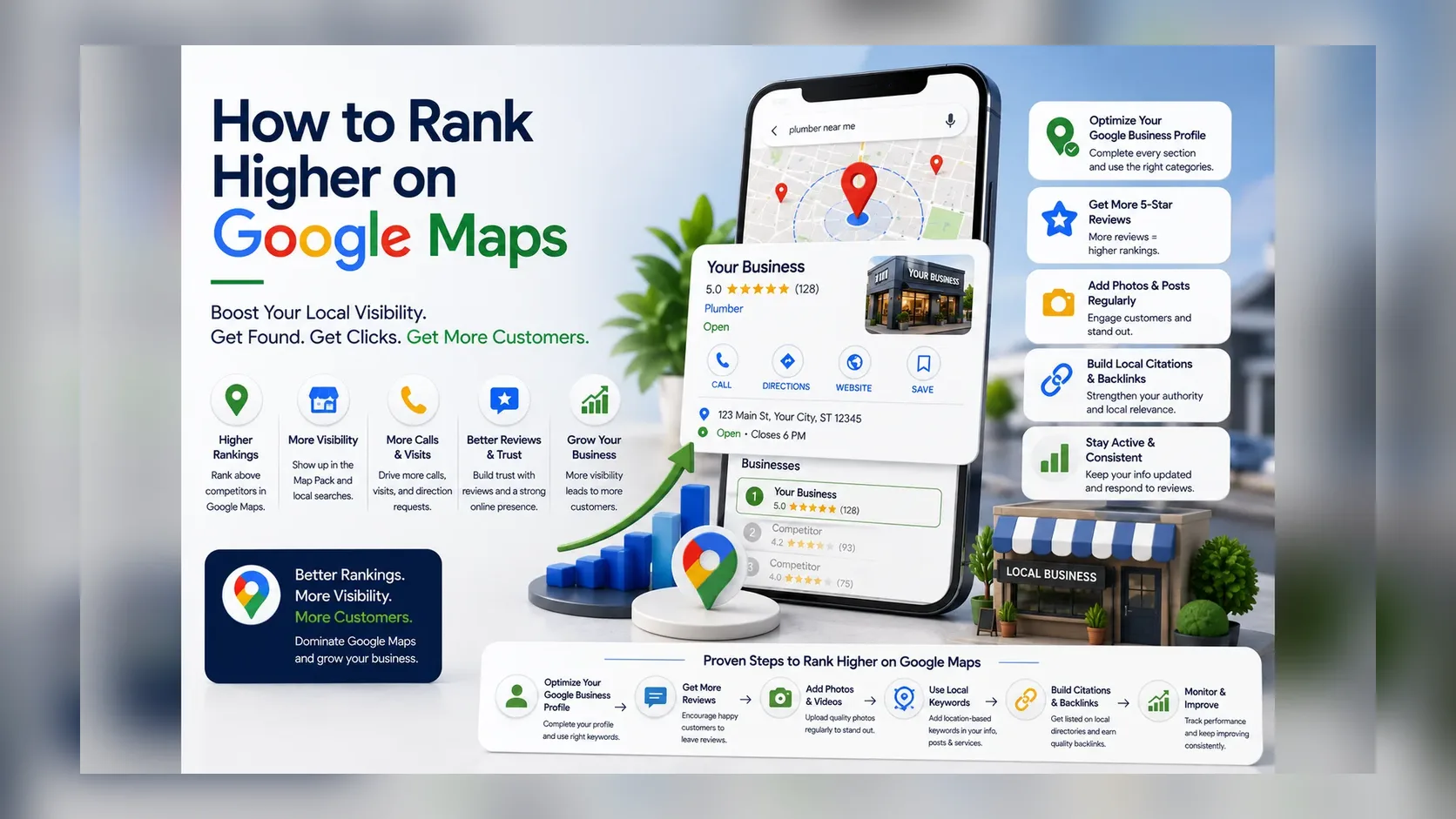
That ordering shapes where to spend effort. If your Business Profile is incomplete or you have few reviews, fix those first. My guides on Google Maps ranking factors and how to rank higher on Google Maps cover that groundwork. Links come after.
What Is the Difference Between Citations and Backlinks?
People mix these up, and some agencies blur them deliberately to pad a package.
Many directory listings give you both: the listing is a citation, and the link back to your site is a backlink. But a news article that mentions your shop by name without a link is a citation too, and some of the more useful ones come that way. Whitespark's survey separates structured citations (directory listings) from unstructured ones (news, blogs, government sites and associations) and ranks the quality of unstructured citations at number 37 for local organic results, while structured citation quality ranks at 49 for the map pack. It also reports that overall citation weighting has fallen over several editions.
So citations are worth getting right once, then maintaining. They are not something to keep buying.
Which Backlinks Help Local SEO Most? A Prioritised List
This is the order I would work through for a typical UK local business. Start at the top, because the earlier items are easier and carry more relevance.
1. Links from your own real-world relationships
Check who already deals with you. Suppliers, manufacturers, wholesalers, landlords, business partners, franchisors, charities you support and clients who are businesses can often link to you from a "stockists", "suppliers", "partners" or "who we work with" page. These are the most natural links a local business can get and usually the cheapest, because you only need to ask.
2. Chambers of commerce and business networks
Your local chamber of commerce typically lists members with a link, and the British Chambers of Commerce network covers most regions. Membership costs money, so decide whether it is worth it for the networking first, with the link as a bonus. The Federation of Small Businesses also runs a member directory, which suits sole traders and small firms. Regional and town business groups, BNI chapters and local enterprise partnerships often have similar member pages. Check each one before joining so you know whether the page is indexed and links out.
3. Trade and industry associations
Whatever your trade, there is probably a body that lists vetted members: electrical, plumbing, building, accountancy, legal, dental and so on. Because these lists are limited to qualified members, they are the sort of link that signals real credibility. They are also relevant to your category, which matters more than raw authority. Only join bodies you genuinely qualify for, because the membership itself must be real.
4. Local news and community sites
Local newspapers, hyperlocal news sites, community blogs and parish or town websites link to businesses when there is a story. Useful angles include opening a new site, hiring locally, a charity fundraiser, an anniversary, a useful seasonal tip from an expert in your field, or a comment on a local issue. Pitch editors with something worth printing. A press release that is only an advert for your service gets ignored. If a journalist asks for expert comment through a service, a quoted answer with a link back to you is a legitimate result.
5. Local sponsorships, events and charities
Sponsoring a youth football team, a local show, a school fair or a charity run often earns a link from the organiser's website, and sometimes coverage in the local paper. These work because there is a real relationship behind them. Be careful about how you describe it. If the only reason for the sponsorship is the link, the organisers and Google will both notice. Sponsor things you would support anyway, and treat the link as a side effect.
6. Local resource pages and partnerships
Councils, libraries, universities, colleges and local business support organisations publish "local services", "approved suppliers" or "business directory" pages. Colleges and universities sometimes link to local employers who offer work experience or apprenticeships. These links are relevant and carry good trust. They take a polite email, not a campaign.
7. Reputable directories and citations
Do the basics once, with identical details everywhere:
- Google Business Profile, Bing Places and Apple Business Connect, which are the primary sources, and which Whitespark's survey places at number 28 for citation consistency in the map pack.
- A few established UK directories such as Yell and Thomson Local, if your trade is listed and the free listing is genuine.
- Industry or review platforms that your customers actually use, such as Checkatrade or TrustATrader for trades, if you qualify.
- Facebook, LinkedIn and other profiles you control.
Keep a spreadsheet of each listing, login and the exact name, address and phone format you used. Google's guidance says the business name should match your real-world name, and the address or service area should be accurate, so keep the details identical.
8. Your own content that earns links
Local guides, price explainers, "what to know before hiring" pages and data you gather yourself can attract links from local bloggers, forums and news sites. This is the slowest option and the least reliable, but it is the only one that scales without paying anyone.
Want this done for you? Message me directly on WhatsApp and I'll review your current links and citations, then tell you which of these are realistic for your business and area.
How Do I Find Local Link Opportunities?
You do not need a paid tool to start.
- Look at competitors. Search for your main local rivals in a backlink checker and note which sites link to them. Free tools show a limited sample, which is enough to spot patterns such as a chamber, a trade body or a local news site.
- Search for local lists. Try searches like "[your town] business directory", "[your trade] association members", "[your town] sponsors" and "[your town] community groups".
- Check your own mentions. Search your business name and see which sites mention you without linking. Ask them to add one.
- Review your relationships. List suppliers, partners, clients, charities and local organisations. That list is usually your best set of leads.
- Check the page before you ask. The page should be indexed, relevant and from a real organisation. A page with 200 links to unrelated businesses is not worth the effort.
Use Search Console's links report to see who already links to you. It will show you which of these steps you have effectively completed.
What to Avoid When Building Local Links
- Mass directory submission. Submitting to hundreds of directories creates inconsistent listings and low-quality links. A handful of good ones does the job.
- Bought links and link packages. Google's spam policies list buying and selling links as link spam. I explain how to judge them in my guide to link building packages.
- Link exchanges. "I'll link to you if you link to me" at scale is also on Google's list.
- Exact-match anchors on every link. "Plumber in Leeds" repeated across dozens of links looks manufactured. Brand names and natural phrases are safer.
- Fake addresses and virtual offices. These cause Business Profile problems and do not help links. See my guide for service-area businesses if you work from home.
- Inconsistent business details. If your name, phone or address differs between listings, you weaken the signal you are trying to build.
- Links from irrelevant foreign sites. A link from a site in another country and another language gives no local signal.
- Review-for-link schemes. Offering discounts for reviews breaks review policies. Keep reviews separate and follow the rules in how to get more Google reviews.
How Many Local Backlinks Do You Need?
There is no universal number. The practical method is to compare your local competitors, the ones who currently rank above you in the map pack or in organic results for your main searches. Check how many distinct, relevant sites link to them and what kinds. If the leader has fifteen genuine local and industry links and you have two, the gap is clear. If the leader has hundreds of junk links, the gap is not worth copying.
Quality and relevance beat volume. A single link from a respected trade body or the local paper can do more than a dozen directory listings.
A 90-Day Plan for a Local Business
If you want a sequence, this is a reasonable one. It is intentionally modest.
Weeks 1 to 2: Finish your Business Profile, Bing Places and Apple Business Connect listings with identical details. Fix any inconsistent listings you find. Add a link to your site on every profile you control.
Weeks 3 to 6: Contact suppliers, partners and clients for a link or a "who we work with" mention. Apply for relevant trade association and chamber memberships if they make sense on their own merits. Add two or three reputable directories.
Weeks 7 to 12: Pitch one genuine story to the local paper or community site. Sign up for a sponsorship or event you would support anyway. Create one useful local resource on your site and share it with relevant local groups.
Then review. Look at map rankings, calls, direction requests and enquiries, not link counts. Local SEO is slow, and the timeline in how long local SEO takes is worth reading before you judge results.
When to Hire Help With Local Link Building, and When Not To
Do it yourself when you have time and the list above is mostly about asking people you already know. Most of the best links come from relationships you own, and an outsider cannot manufacture those for you.
Hire help when you are in a competitive area and the gap with rivals is large, when you need outreach and pitching done consistently, when you suspect past providers built poor links, or when you run multiple locations and need consistent listings across all of them. My Google Business Profile and local SEO service covers profile optimisation, citation clean-up and local authority work, and I quote after reviewing your situation. I do not publish prices.
Do not hire anyone who promises a set number of links, sells packages of "local backlinks" for a flat fee, or says directory submission to hundreds of sites will get you into the map pack.
Conclusion: The Best Backlinks for Local SEO
The best backlinks for local SEO are the ones a real local business would earn anyway: from suppliers and partners, your chamber and trade body, the local paper and the events you support. Citations in a few reputable directories give you consistency, and then you stop. Everything else, from bulk submissions to purchased packages, adds risk without adding prominence.
If you want help working out which links are realistic for your business, message me directly on WhatsApp or use the contact page. Tell me your trade and town, and I'll tell you where I would look first.

 Discuss on WhatsApp